
China's ruling Communist Party has cracked down on Tibetans who planned to attend the Kalachakra Puja in Bodh Gaya. But the Tibetan people have dared the Communists by listening to the Dalai Lama's sermons on the Internet and sharing videos on social media.
'Our air force can strike them with impunity.'

Important for Chinese President Xi Jinping will be Zhao's discussions on the issues of Tibet and the Dalai Lama and his assessment of the likely results of India's coming national elections, notes former senior RA&W officer and China expert Jayadeva Ranade.
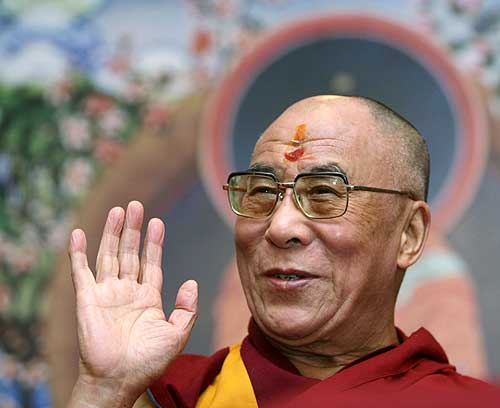
'The first time that China alleged the Dalai Lama was 'anti-national' and 'unpatriotic' was after he affirmed that Arunachal Pradesh and Tawang are part of India,' points out former RA&W official Jayadeva Ranade.

The Dalai Lama is 84 years old now and the issue of his successor has gained prominence in the last couple of years in the wake of his health issues.

China is building the world's highest-altitude cloud computing data centre in Tibet that will meet the data storage needs of the country and South Asian nations like Nepal, Bangladesh and Pakistan, official media reported on Thursday.

Arpi deserves to be complimented for the commitment and hard work that have gone into this production. The frustrations of seeking reliable documentation from the catacombs of the Indian bureaucracy did not deter him from going after the best information available, and the result is one that he can take much satisfaction in. Ambassador Prabhat P Shukla, Member Advisory Council, Vivekananda International Foundation, reviews Claude Arpi's The End of an Era: India Exits Tibet.

'China is concerned about its impact within Tibet.'

'If the central government does not give rights to the people of Ladakh, then it won't be good for our country.'

For India to endorse Nepal's Buddhist conference will be like sipping from a poisoned chalice, warns former RA&W official Jayadeva Ranade.

It is not clear yet what impact the blockade of the river will have on the flow of water from the Brahmaputra into the lower riparian countries like India and Bangladesh as a result.

'Its aim is to force the Bhutanese government to cede territory that China wants elsewhere in Bhutan to give Beijing a military advantage in its struggle with New Delhi.'

The Standing Committee on Water Resources has recommended renegotiating the Indus Water Treaty with Pakistan to address the impact of climate change on water availability in the river basin and other challenges which are not covered under the agreement.
China's parliament on Thursday adopted the 14th Five-Year Plan, the mega blueprint containing billions of dollars worth of projects, including the controversial hydropower project on the Brahmaputra river in Tibet close to the Arunachal Pradesh border over which India has raised concerns.

'The need of the hour is to build on the positives and control the negatives,' says Colonel (Dr) Anil A Athale (retd).
The over 3,800-km-long Brahmaputra, one of the longest rivers in the world passes through China, India and Bangladesh and has several tributaries and sub-tributaries.

The 7.9 Richter Scale temblor that struck Nepal on Saturday also affected parts of Tibet. The two border ports to Nepal were seriously affected.

The world must hang its head in shame for being a mute spectator to the 'cultural holocaust' in Tibet, says Major General Mrinal Suman (retd).
'While wishing the Tibetan leader a long and healthy life, one can hope for a 'selection' of the Tibetan leader in the Indian Himalayas.' 'It is vital for Tibetan Buddhism, but it is also in India's political interests,' says Claude Arpi.

Major General Sujan Singh Uban, a legendary veteran of the Second World War, was a natural choice to raise, train and command the Special Frontier Force and mould them into a well oiled fighting machine, recalls his son Inspector General Gurdip Singh Uban (retd), who led SFF troops during the Kargil War.

The people who know Tibet will continue to fight the good fight. Long, hard, less than hopeful, but always peaceful.

The chaos on its stock markets, a fierce battle between the old and new guard in the Communist Party and the restive border provinces of Tibet and Xinjiang forebode tough times ahead for China, says Claude Arpi.
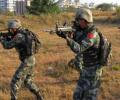
The brigade that conducted the drills was from the PLA's Tibet Military Command and is one of China's two plateau mountain brigades.

China is worried about the situation post the Dalai Lama and that his reincarnation could surface in Arunchal Pradesh, a region it claims as its own, but which is part of the Indian Republic, says former RA&W Additional Secretary Jayadeva Ranade.

'Lhasa is more than the Unesco World Heritage Sites it boasts of. It is more than a gateway to the mighty Himalayas.' 'It is about the warmth of its people: Unsaid, unspoken, but felt everywhere,' discovers Shruti Bajpai.

Situated at a height of 15,200 feet above sea level, the pass sits on the top of a craggily formed Himalayan range that separates the Tibetan plateau from the Indian sub-continent.

Tawang is very much a part of India, and if the present Dalai Lama decides one day to take rebirth in Tawang, the Indian government will openly welcome him and support him, notes Claude Arpi.

'The missile mounted near Kailash-Mansarovar is called DF-21. It is a medium-range, 2,200 kilometres ballistic missile. Its advantage is that it can cover all cities of north India, including New Delhi'

'If you behave like a nail, the adversary will behave like a hammer.'

The expulsion is likely to cloud India-China ties as Narendra Modi visits China for the G-20 Leaders Summit on September 4-5 and Xi Jinping is scheduled to be in Goa for the BRICS meeting on October 15-16.

Overall, the People's Liberation Army Air Force (PLAAF) has focused on building ground-based air defense networks and network-centric operations rather than trying to match the Indian Air Force (IAF) in terms of straight fighter numbers along the border. All air assets fall under the Western Theater Command of the PLA, the largest geographic region of China's five military theater commands.

'If, as appears to be the case, India is on way to 'mending fences' with China, and China is equally desirous to 'reset' the relationship, this could be a self-reflexive moment in India's positioning vis-a-vis not just the Dalai Lama, but also the Tibetan issue and China as a whole,' points out China expert Alka Acharya.

'Intrusions by PLA troops in the Ladakh sector are more in number than elsewhere and this region is now likely to remain an area of enhanced Chinese interest,' warns China expert Jayadeva Ranade.

A decade has seen many welcome changes in this hill district of Jammu and Kashmir, says Anjuli Bhargava.

Beijing is clearly rattled by the Dalai Lama's visit. Unlike the 2009 visit, which was a four-day religious tour, the current visit is a high-decibel, 10-day affair, without the fig leaf of a "religious event", reports Ajai Shukla.

'Clarifying that modernisation of national defence and armed forces should be completed by 2035, Xi Jinping asserted the goal is to make the People's Liberation Army a "world class force" that "can fight and win" by 2050,' points out former RAW officer Jayadeva Ranade.

Thirty years after the massacre at Tiananmen Square, coerced collective amnesia envelops the Chinese nation about that horrific event. Claude Arpi glances back at how the student uprising could have changed the Middle Kingdom forever had the Chinese Communist party not traveled on the route of martial law.

Since 1950 successive governments have tried various options but failed to reduce alienation amongst the people, for different reasons, of Kashmir, Jammu and Ladakh. It is best to accept this reality and let each region charter its own path, within the framework of the Indian Constitution, says Sanjeev Nayyar.
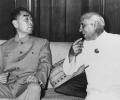
'Unquestionably, the spirit behind the Panchsheel agreement and the 'Hindi Chini bhai bhai' slogan were thrown overboard by the Chinese, and a trust deficit was injected between the two nations.' A revealing excerpt from General J J Singh's The McMahon Line: A Century Of Discord.

The massive earthquake in Sichuan struck at 9:19 pm (local time) on Tuesday and the epicentre was monitored at a depth of 20 km, state-run Xinhua new agency reported.
 © 2026 Rediff.com - Advertise with us - Disclaimer - Privacy Policy - Sitemap - Feedback - About us - Terms of use - Grievances